MSoftech · Apr 2025 – Nov 2025

Clinical
Nursing EMR

An AI-powered EMR simulation platform that bridges the gap between clinical practice and nursing education. 6 AI Agents evaluate student performance across 55 criteria in real time.

6
AI Agents
55
Evaluation Criteria
40K+
Log Entries
90%
Time Reduction
Clinical Nursing EMR
Overview

Project Overview

Nursing students practice clinical workflows in a real hospital-grade EMR environment — covering OCS, ENR, Lab, and PACS — exactly as they would on an actual ward. Every action, every input, every decision is captured as a structured evaluation log in real time.

The evaluation engine was built on domain knowledge, not just code. We mapped actual clinical nursing protocols — ward rounds, medication administration, vital sign assessment, intake/output management — and translated them into 55 structured evaluation criteria that mirror real professional standards. Upon completing a simulation, 6 specialized AI Agents automatically assess each student's performance: identifying what they did well, what needs improvement, and why — with structured, actionable feedback.

This architecture delivers measurable outcomes: evaluation time reduced by 90% compared to manual grading, full consistency across 100+ students per cohort, and professor workload cut by 40% — shifting their role from repetitive scoring to targeted clinical mentoring. The system has processed over 40,000 evaluation logs in production.

Period
Apr 2025 – Nov 2025
Type
MSoftech Product
Role
AI Solutions Architect · Full-Stack Engineer
Domain
Healthcare · AI · Education
Domain Foundation

Clinical Standards

임의로 만든 기준이 아닌 공식 간호 표준 기반

Evaluation systems in regulated domains cannot rely on approximations. Each of the 55 criteria in this platform is systematically codified from published Korean national nursing standards — the clinical references that underpin nursing licensure and professional practice guidelines. We design evaluation engines only after clinical judgment is formally mapped at the protocol level, because healthcare AI that settles for 'mostly correct' becomes a liability the moment it enters production.

Practice Guide
기본간호학 실습 지침서
Vitals Standard
대한간호협회 활력징후 측정 표준
Patient Safety
환자안전 지표 · Morse Fall Scale
VITAL SIGNS
Measurement Tolerances
BT: ±0.2°C
HR: ±3 bpm
RR: ±2/min
BP: ±5 mmHg
SpO2: ±1%
MEDICATION
The 5 Rights
Right Patient
Right Drug
Right Dose
Right Route
Right Time
NURSING RECORDS
F-DAR Format
Focus
Data
Action
Response
SAFETY
Risk Assessment
Morse Fall Scale
9-Category Initial
Pain NRS (0-10)
Danger Value Flag
How It Works

System Overview

STUDENT ACTIVITY Practice Session Save Practice Output Generate Action Log HUMAN-IN-THE-LOOP (EVALUATION MANAGEMENT) 1. AI FIRST PASS Run 6 AI Agents 2. REVIEW (CORE) Monitor AI Output Review AI Prompts & Feedback Verify Student Action Logs 3. CONFIRMATION Approve Final Score STUDENT RESULT Grade Report & Detailed Feedback
A student completes a clinical simulation, and the system captures two outputs: structured practice data and a granular action log. These flow into 6 specialized AI Agents for automated first-pass evaluation. From there, the professor takes over — reviewing AI-generated scores alongside the full prompt context and raw student action logs — before approving or adjusting the final grade. Only after this human confirmation does the result reach the student.
AI Agents

Evaluation Engine

6개 전문 Agent — 각각 독립된 임상 영역을 전담

VitalSignsAgent
Measurement Accuracy
BT ±0.2°C · HR ±3 bpm
RR ±2/min · BP ±5 mmHg
MedicationAgent
5 Rights Protocol
Patient · Drug · Dose
Route · Time
NursingRecordAgent
F-DAR Documentation
Focus · Data
Action · Response
IoAgent
Intake / Output
Recording accuracy
and completeness
InitialAssessmentAgent
9-Category Assessment
Patient safety · Pain
Fall risk · Consciousness
ActionLogAgent
Behavioral Sequence
Action vs expected
clinical workflow

All 6 agents run in parallel against the same student session, producing 28 independent evaluation criteria in a single pass. Every criterion traces directly back to the clinical standards defined above.

Evaluation Philosophy

Human-in-the-Loop

AI는 제안하고, 인간이 결정합니다 — 아키텍처에 내재된 안전성 설계

Every AI evaluation in this system is a draft, not a verdict. Before any score reaches a student, a professor reviews the full AI reasoning alongside raw action logs — and can approve, adjust, or override. This isn't a compliance checkbox added at the end. Human oversight was embedded into the architecture from day one, following the same structural principle that FDA SaMD and EU AI Act require: AI proposes, humans decide.

REVIEW
What the Professor Sees
→ Full prompt transmitted to the LLM — 28,873 characters, version-controlled
→ AI's complete reasoning and structured feedback, not just the final score
→ Every student action — logged at the keystroke level with timestamps
→ Clinically critical values auto-flagged with full contextual data
CONTROL
Professor's Control
→ Approve or override AI-generated scores
→ Adjust individual category scores without affecting others
→ Selectively re-execute any single agent for re-validation
→ Append domain-specific comments and learning points
Production Infrastructure

Full Observability

모든 LLM 호출의 투명한 추적, 기록 및 재실행을 통한 신뢰성 확보

TRACEABILITY
Full Pipeline Tracking
Session context, token usage, and schema validation — every step of the AI reasoning process transparently logged.
RE-EXECUTION
Independent Re-run
Any individual LLM call can be independently re-executed from logged data — precise issue reproduction and root cause analysis.
RELIABILITY
Enterprise-Grade Trust
Debugging — rapid error resolution
Incident Traceback — precise failure analysis
Compliance Audit — regulatory adherence proof
PROMPT ENGINEERING
Production-Scale Prompt Management
→ Structured prompts at production scale — 28,873 characters, versioned and reviewable
→ JSON Schema validation enforced on every response — zero tolerance for malformed output
→ Mode-branched prompts: GUIDED (learning) vs EVALUATION (assessment)
→ Built-in guardrails against hallucination and format drift
Features

Key Screens

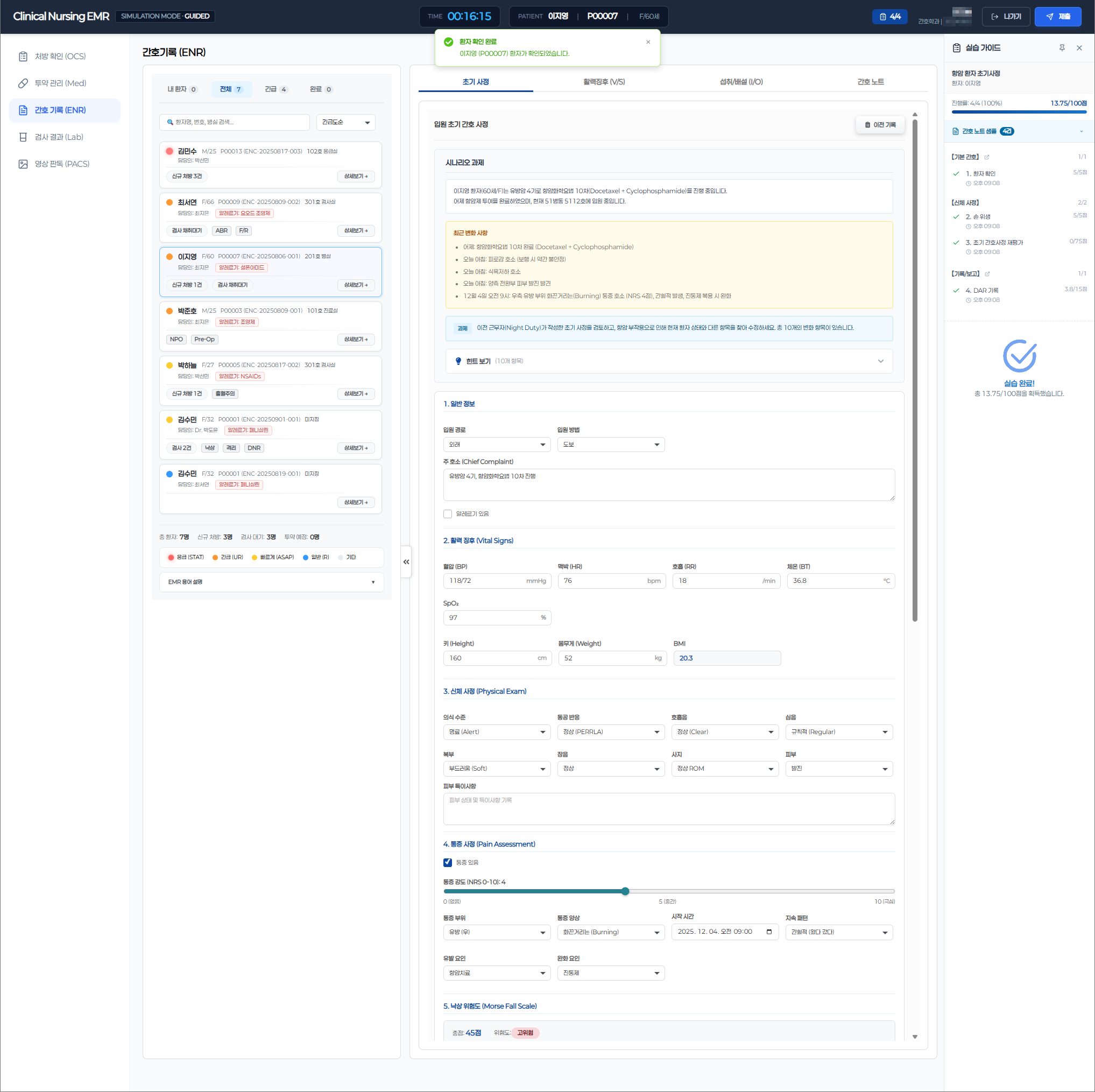
간호기록 (ENR) · GUIDED MODE
Nursing Record
Students practice in a real hospital EMR environment. Records Initial Assessment, Vital Signs, I/O, and Nursing Notes in real time with step-by-step progress tracking.
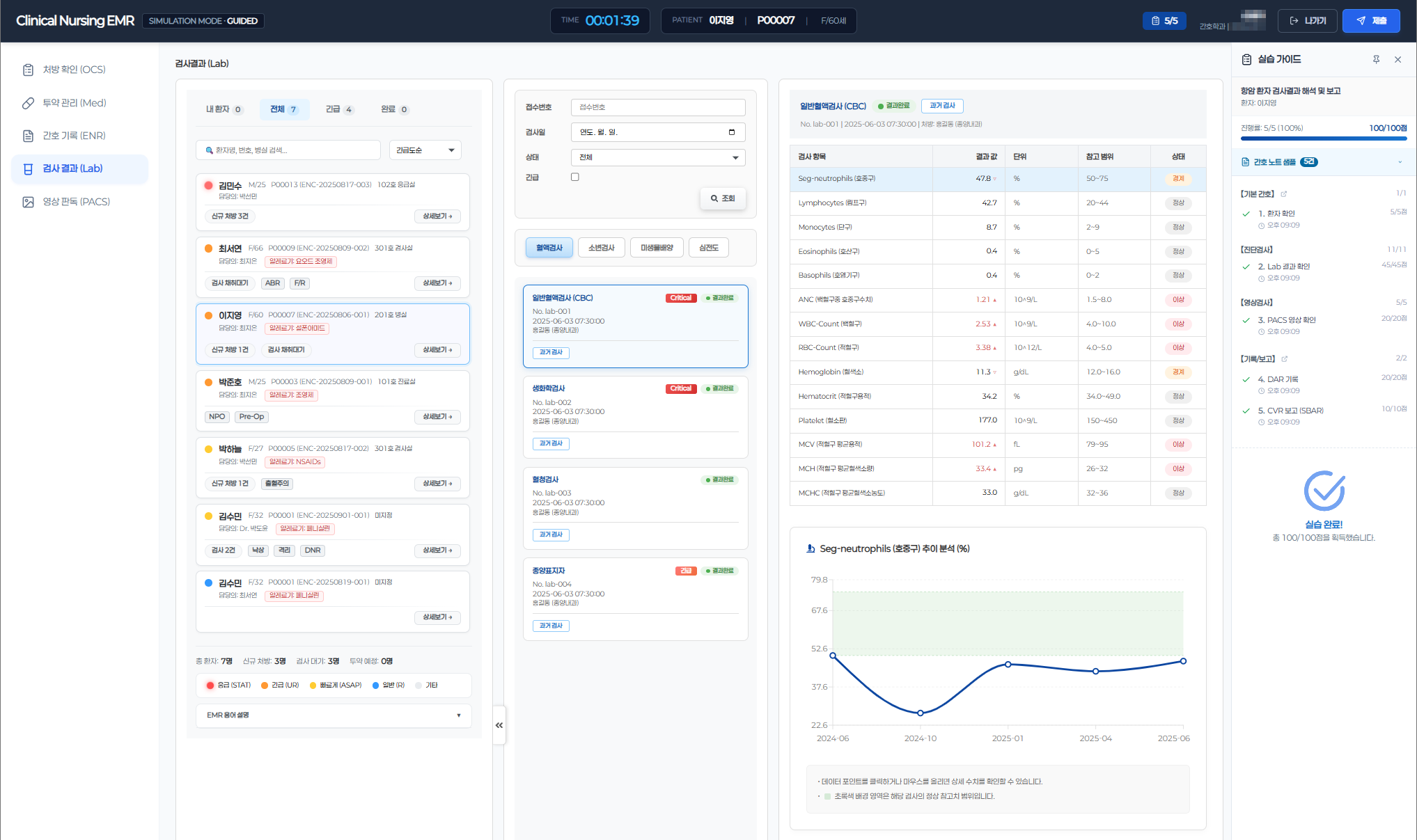
검사결과 (Lab)
Lab
CBC, biochemistry results with trend charts. Critical values highlighted, nursing action reports auto-generated.
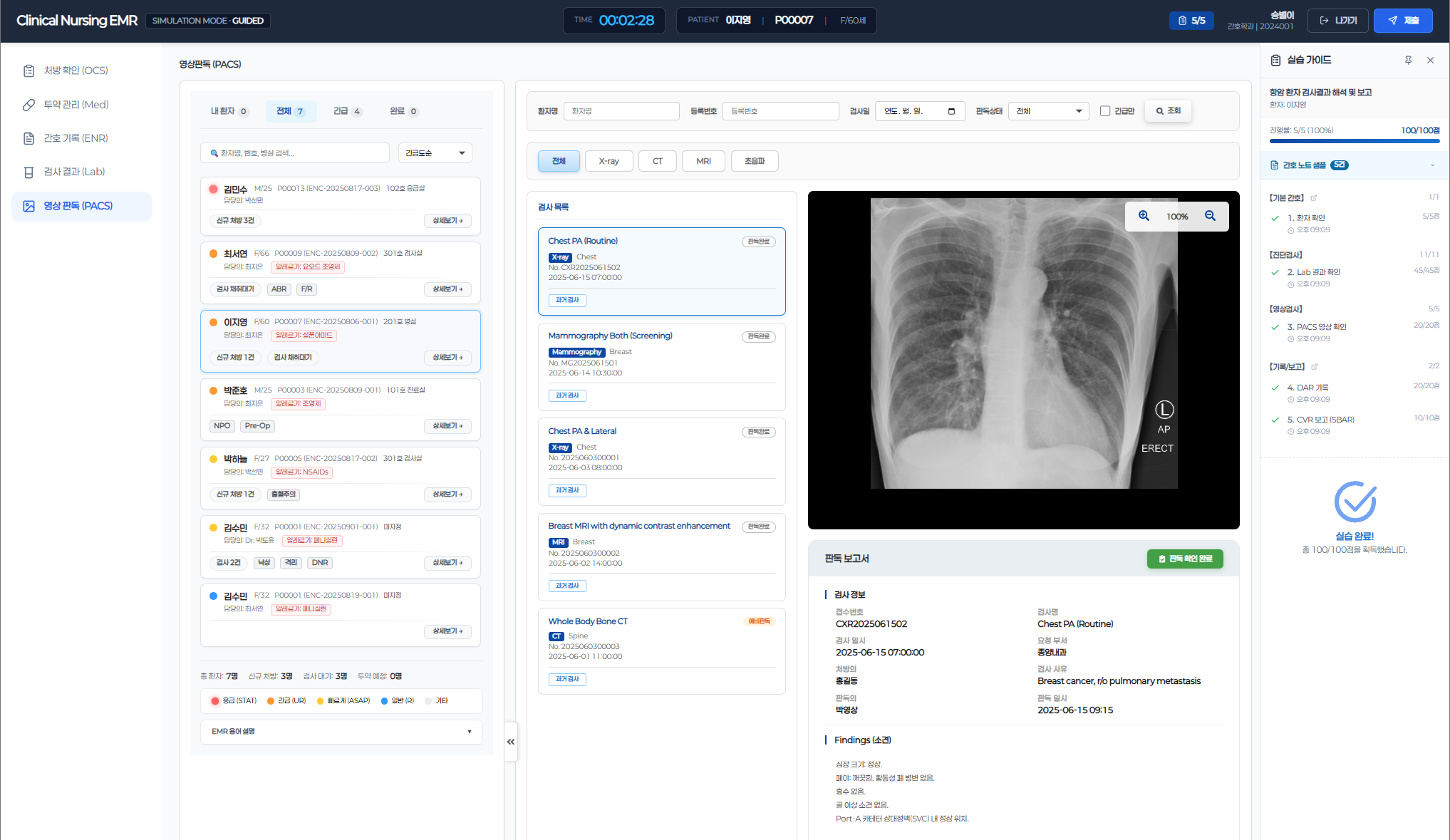
영상판독 (PACS)
PACS
X-Ray, CT, MRI images with diagnostic reports. Findings + Impression sections simulate real clinical reading.
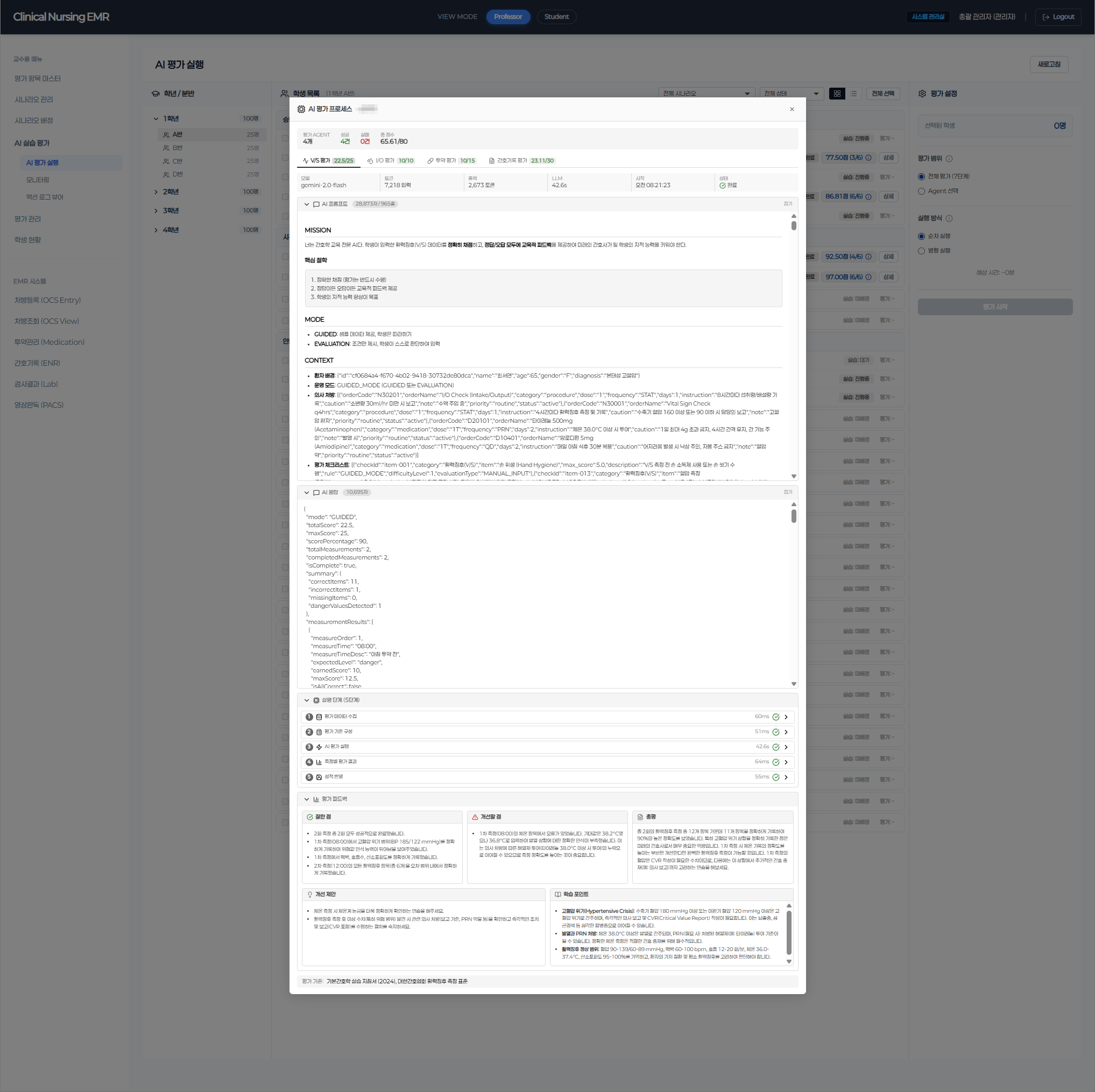
AI 평가 실행 · Vertex AI (Gemini 2.0 Flash)
AI Evaluation
Full AI prompt, patient context, and JSON response are logged transparently. Each agent's score and detailed feedback visible in real time.
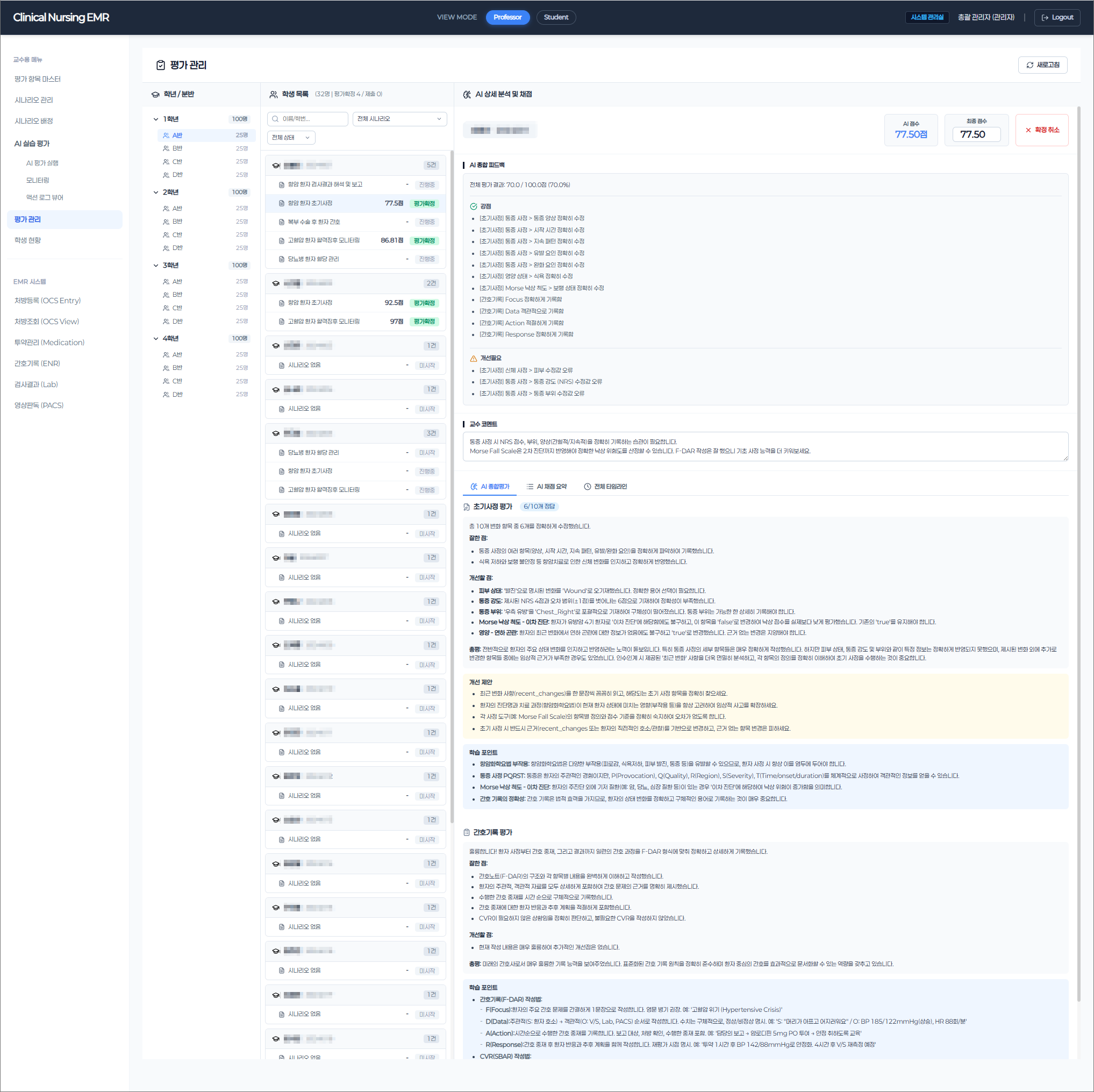
교수용 평가 관리 대시보드 · Professor View
Professor Dashboard
Professors review AI scores with category-level feedback (correct / caution / needs improvement). Final scores approved or adjusted with one click.
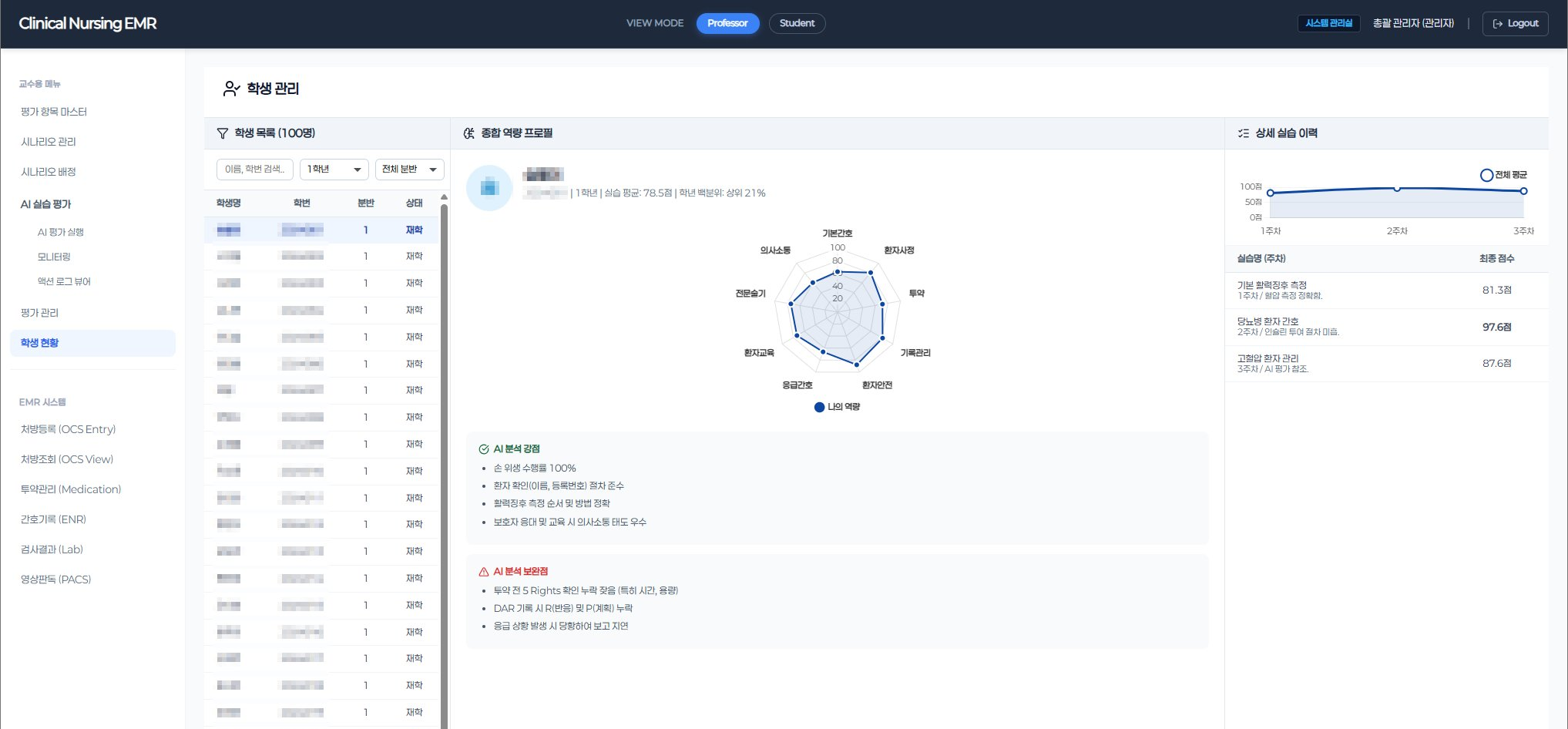
학생 현황 · Student Competency Profile
Student Dashboard
Each student's clinical competency visualized as a 9-dimension radar profile — from patient safety to documentation accuracy. AI-generated analysis identifies strengths and specific areas for improvement, with score trends tracked across sessions.
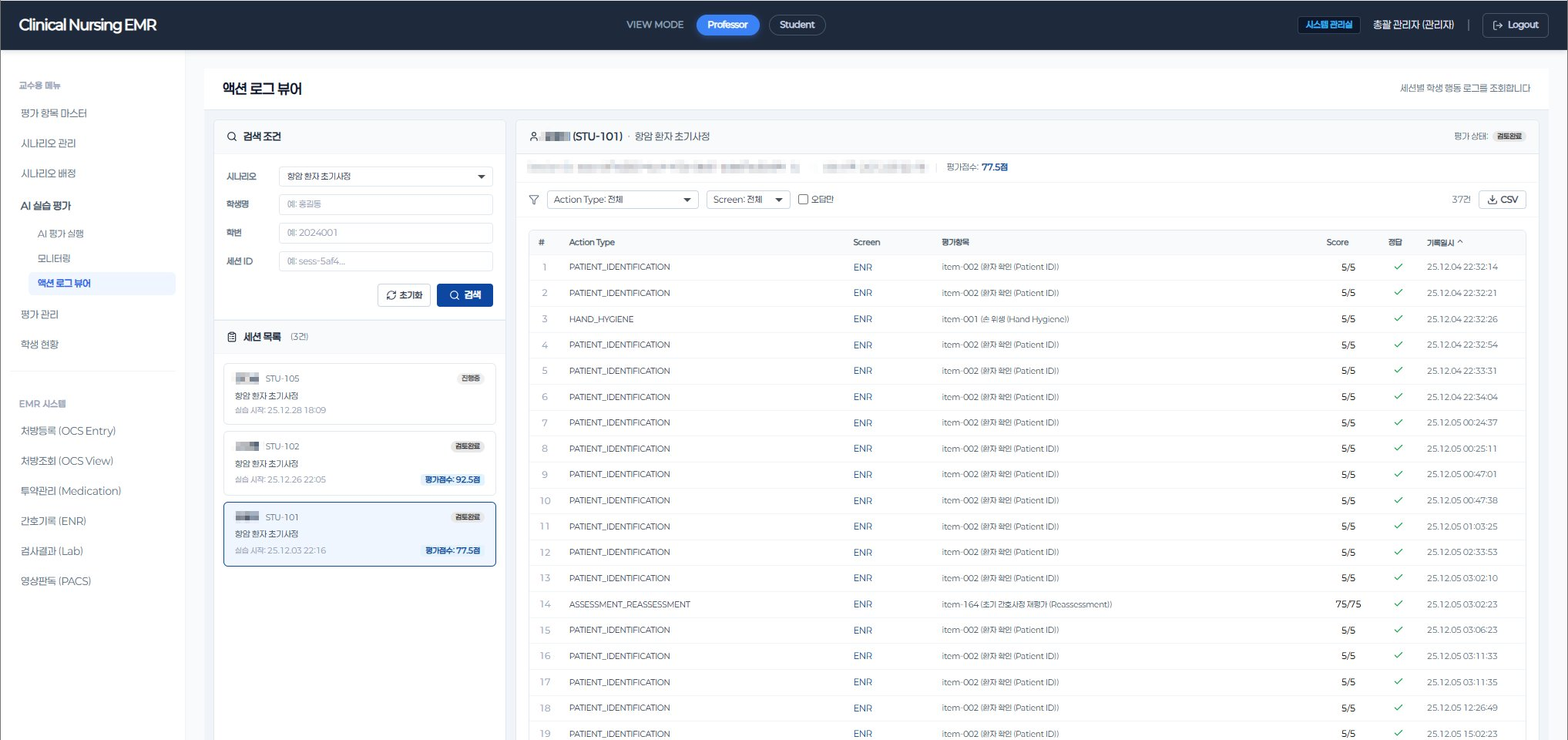
액션 로그 뷰어 · Action Log Viewer
Action Log Viewer
Every student action — navigation, data entry, clinical decision — recorded with action type, screen context, evaluation score, and timestamp. Enables granular analysis of clinical reasoning patterns and serves as the evidence base for AI evaluation.
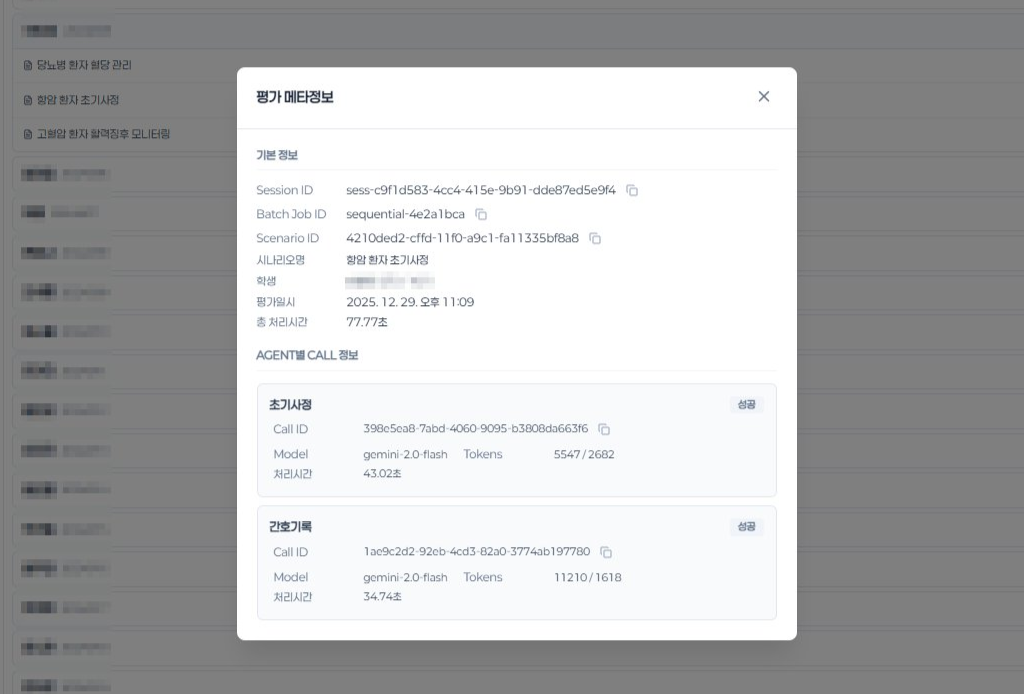
AI 평가 모니터링 · LLMOps Dashboard
LLMOps Dashboard
Full LLMOps visibility — every Agent call surfaces its Call ID, token consumption, and processing latency. Reviewers can inspect any call's complete trace or trigger selective re-execution of individual Agents without affecting the rest of the pipeline.
Results

Impact

90%
Evaluation Time Reduction
100%
Evaluation Consistency
40%
Professor Workload Reduction
40K+
Evaluation Logs Processed
Technology

Tech Stack

Frontend
React 18TypeScriptViteAG GridWebSocket
Backend
Spring Boot 3.xJava 17JPAMariaDBRESTful API
AI Engine
Google Vertex AIGemini 2.0 FlashPrompt EngineeringJSON Schema
Infrastructure
GCP Cloud RunCloud SQLCloud Storage
← Back to Projects Next: FHIR EMR →